

![FIFA World Cup 2026 launch signals a new football era for Pakistan [TNS]](https://footballpakistan.com/wp-content/uploads/2026/05/2026-FIFA-World-Cup-launch-event-at-US-Embassy-Islamabad-1.jpg "FIFA World Cup 2026 launch signals a new football era for Pakistan [TNS]")
by Sarfraz Ahmed
For decades, football in Pakistan survived more on passion than structure. The country produced world-famous footballs, supplied international tournaments through the manufacturing excellence of Sialkot, and nurtured millions of football lovers in streets, schools, and neighborhoods, yet remained disconnected from the global football conversation where it mattered most: development, governance, infrastructure, and international competitiveness.
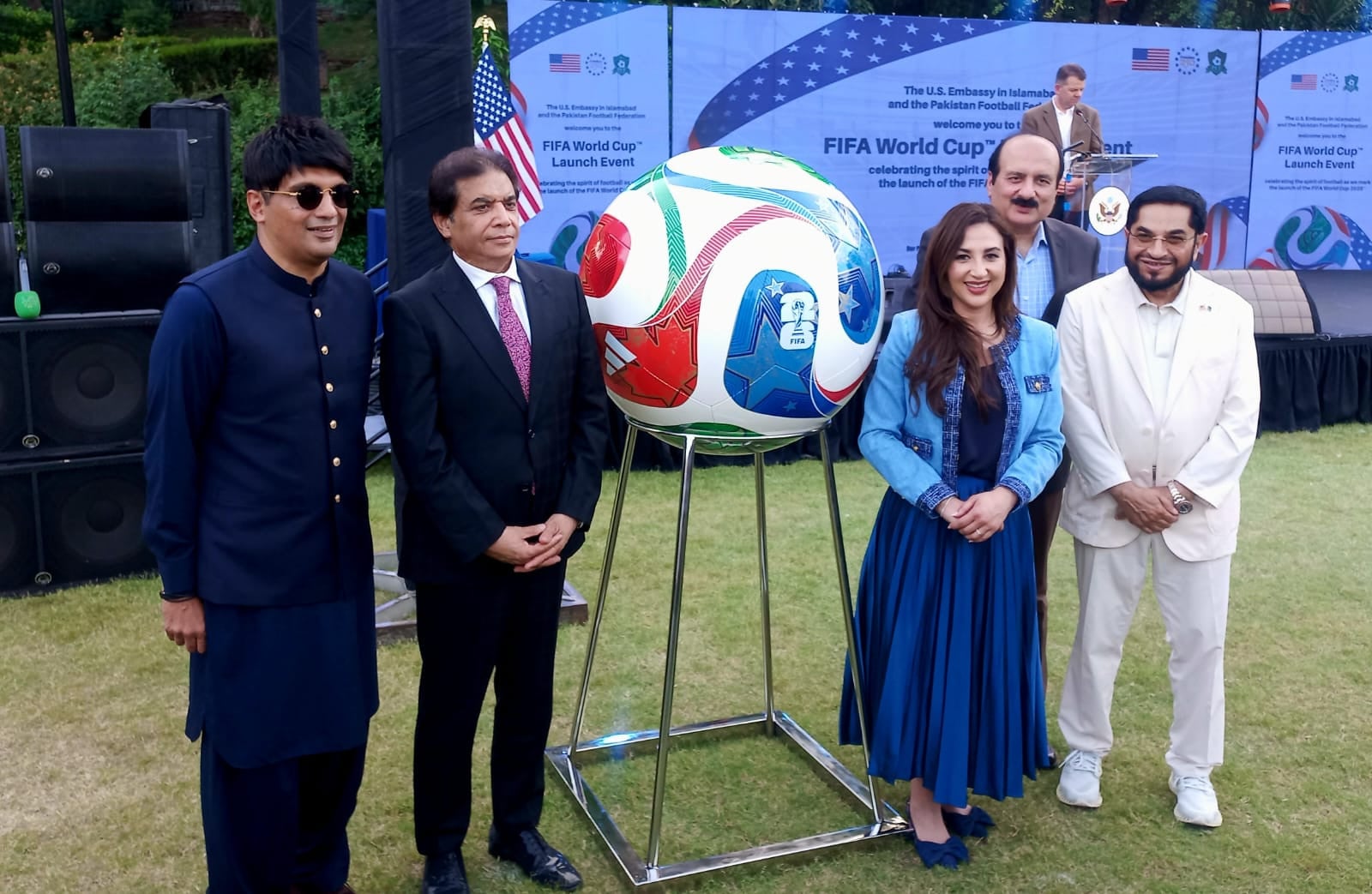
That is why the recent FIFA World Cup 2026 launch ceremony hosted by the United States Embassy Islamabad in collaboration with the Pakistan Football Federation (PFF) carried significance beyond symbolism and celebration.
The event, attended by diplomats, federal ministers, sports administrators, corporate representatives, and football stakeholders, was not merely a ceremonial countdown to the next FIFA World Cup. It was a reflection of Pakistan’s evolving football identity and a reminder that the country may finally be entering a serious phase of football reintegration after years of administrative instability and lost momentum. For Pakistani football, that matters enormously.
The launch itself was visually impressive and diplomatically important. But the larger story was the message emerging from the platform: Pakistan is trying to reconnect with the global football ecosystem at a time when the sport is becoming increasingly influential socially, commercially, and culturally.
The presence of FIFA President Gianni Infantino through a special video address gave the event unusual weight. His praise for PFF President Syed Mohsen Gilani and acknowledgment of Pakistan’s recent football progress signaled something the country has not experienced consistently in years, international confidence. That confidence was not accidental.
Pakistan football has spent much of the past decade trapped in crisis. Administrative disputes, FIFA suspensions, governance controversies, and institutional fragmentation severely damaged the sport’s growth. While neighboring countries invested heavily in leagues, academies, women’s football, youth structures, and commercial development, Pakistan largely remained stagnant.
As a result, football in Pakistan became disconnected from its own potential. Yet despite these setbacks, the appetite for football never disappeared. In many parts of the country, football remains the most accessible and widely played sport after cricket. From Lyari to Chaman, from Karachi to Punjab’s urban centers, football culture has survived through community passion rather than institutional support. That grassroots passion is now beginning to align with renewed administrative momentum.
The Islamabad launch highlighted several encouraging developments that deserve attention beyond the ceremonial glamour. One of the most important among them is Pakistan’s increasing focus on youth and grassroots football development.
The launch of FIFA’s Football For Schools initiative and the establishment of FIFA Arena mini-pitches may appear modest internationally, but within Pakistan’s sporting landscape, such projects represent necessary foundational work. Pakistan football cannot progress through isolated events alone. Sustainable growth depends on infrastructure, school participation, coaching pathways, youth competitions, and administrative continuity. These are not glamorous talking points, but they are the real building blocks of football nations.
This is where the current PFF administration is attempting to change the narrative. The emphasis placed by PFF President Syed Mohsen Gilani on women’s football was particularly significant. Pakistan’s women’s national team participating in a FIFA competition and securing a victory was more than a sporting statistic, it represented social progress within a traditionally male-dominated sporting environment.
Equally symbolic was the appointment of a female manager for the men’s national football team. In many countries this might not generate headlines, but within Pakistan’s sports culture, it signals an important shift toward inclusion and institutional modernization.
These changes matter because football today is no longer just a sport. It is also soft power, identity, business, youth engagement, and diplomacy. That reality was visible throughout the event. The role of sports diplomacy featured heavily in speeches delivered by U.S. Chargé d’Affaires Natalie A. Baker and Federal Minister Hanif Abbasi. Both highlighted how football creates connections that politics alone often cannot. They are correct.
Football possesses a unique ability to build cultural bridges because it operates through emotion, collective identity, and shared experience. The FIFA World Cup is not merely a tournament; it is one of the few global events capable of uniting billions of people simultaneously.
Pakistan’s involvement in that ecosystem, whether through football manufacturing, fandom, or participation, carries long-term diplomatic and economic value. Sialkot remains one of Pakistan’s strongest sporting success stories. The city’s football manufacturing industry has supplied elite-level footballs used across international competitions for decades. Yet ironically, Pakistan historically benefited more economically from football than competitively. That imbalance may slowly be changing.
The excitement surrounding FIFA World Cup 2026 within Pakistan reflects a younger generation increasingly connected to global football culture through digital media, European leagues, gaming, streaming platforms, and social media. Today’s Pakistani football fan is far more globally engaged than previous generations. This creates both opportunity and pressure.
The opportunity lies in building a sustainable domestic football ecosystem that can harness public interest. The pressure lies in ensuring that momentum does not fade after ceremonial launches and media attention disappear. Pakistan has experienced moments of sporting optimism before. The real challenge has always been continuity.
This is why the FIFA launch should not be viewed simply as a successful diplomatic event. It should be viewed as a test of whether Pakistan football can finally convert enthusiasm into long-term institutional growth. There are still major obstacles ahead.
Pakistan lacks modern football infrastructure on a large scale. Domestic competitions require greater consistency and visibility. Youth scouting systems remain underdeveloped. Coaching standards need improvement. Corporate investment remains limited compared to cricket. Most importantly, football governance must remain stable enough to allow long-term planning.
Without structural consistency, optimism alone will not transform Pakistan football. Yet despite these challenges, there is reason for cautious optimism.
The tone surrounding Pakistan football has changed noticeably over the past year. International engagement has improved. FIFA’s support appears stronger.
Women’s football is receiving greater visibility. Grassroots initiatives are expanding. Diplomatic platforms are increasingly embracing football as a cultural connector. These are meaningful developments.
The FIFA World Cup 2026 launch in Islamabad symbolized something Pakistan football desperately needed: relevance. For too long, Pakistan existed on the margins of global football conversations despite its deep emotional connection to the sport. Now, there are signs the country wants to move closer to the center of that conversation. Whether that ambition succeeds will depend not on speeches, ceremonies, or slogans, but on what happens after the applause fades.
Because Pakistan’s football future will ultimately be shaped not inside embassy halls, but on school grounds, community pitches, training academies, and the countless streets where football has always survived, even when the system around it failed.
sarfraznews12@gmail.com