

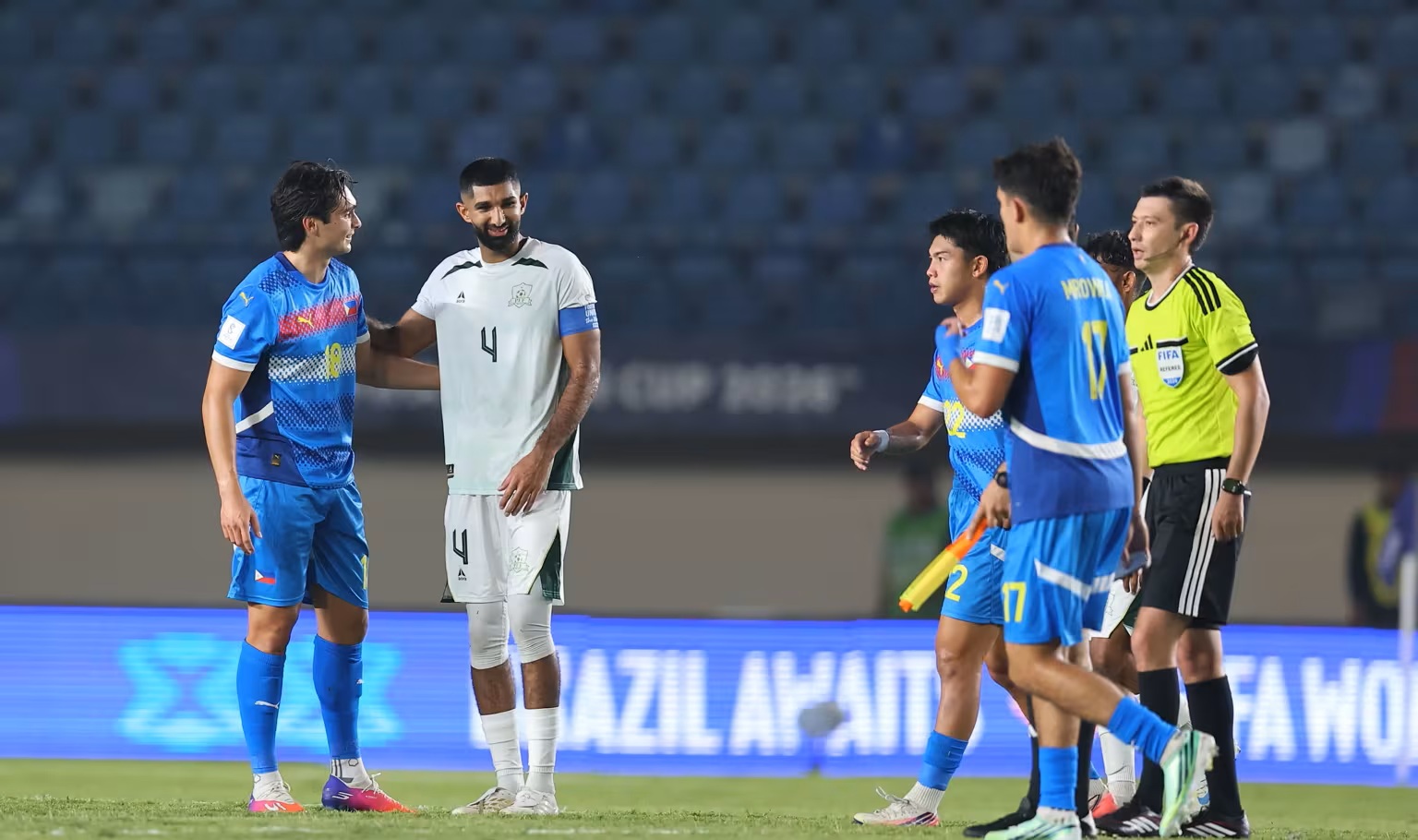
Falling two goals behind did not dent Pakistan’s belief. Instead, they produced the response they needed to turn the game around and secure a 2-2 draw with the Philippines at the FIFA ASEAN Cup 2026™.
For a team fully aware that they sit below most of the other participants in the FIFA/Coca-Cola World Ranking, the result meant more than simply earning a point in the competition. The Falcons showed their ability to compete at a higher level, while also providing evidence of the progress Pakistani football has made in recent years.
Captain Abdullah Iqbal believes the main difference between the first and second halves was not a tactical change, but the courage to execute their game plan with more assertiveness.
“Honestly, we already had a game plan in the first half and I think the tactics were right,” Iqbal told FIFA. “The only problem was that we weren’t aggressive enough. In the second half, we didn’t change anything tactically – we just went out there and played with much more determination, and it paid off.”
Head coach Nolberto Solano acknowledged that the situation was difficult, but his players maintained their belief that they could turn things around. “It’s not easy to come back after going two goals down, but this has been a fantastic experience,” Solano said. “We’re very grateful to be part of this competition, and I hope we can learn a lot from games like this in the future.”
That belief was also rooted in their preparation. Solano revealed that his side had studied the Philippines and knew they had an opportunity to earn a positive result if they worked hard.
“We knew we could get something from the game,” he said. “I think we conceded two sloppy goals in the first half, but we went into the second half with a lot of belief that we could turn things around.”
For Iqbal, the result was proof that Pakistan deserve the opportunity to test themselves at a higher level. However, the captain does not want their achievement to make them lose perspective.
“Showing that we can compete on the pitch is very positive, but we have to stick to our game plan and take things step by step,” said the 24-year-old defender. “We can’t let this result get us carried away either. We have to stay humble and start focusing on preparing our game plan for the next match.”
That attitude reflects the journey Pakistani football is currently on. Iqbal has seen progress, particularly with an increasing number of players building their careers overseas. He believes experience gained in Europe and Asia is helping to raise the level of the national team.
“We know that playing regularly in competitive football is the key to improving, and that’s what we need,” said Iqbal. “But you can see that we have more quality players now. Even when we make substitutions, the quality of our performance remains at a high level. I think that’s the main difference.”
Solano shares that view. According to the Peruvian coach, Pakistan’s next step is to establish stronger foundations through domestic competition.
“Most importantly, I hope we can build a future for Pakistani football because this country has a lot of talented players,” Solano said. “They need to have their own professional league because, at the moment, they don’t have one.”
The draw with the Philippines therefore represents another step in a much longer journey. Pakistan have been given the opportunity to test themselves against opponents who pose different challenges, while the players and coaching staff can use those experiences as a platform for further development.
Their next challenge is already fast approaching, with the side due to play Vietnam on Friday, and Solano knows the match will provide another test of Pakistan’s capabilities.
“It will be another big challenge for us. But, as I said, we’re using games like these as opportunities to learn and gain experience,” he concluded.