

![A digital kick-off, a national surge: Pakistan football finds its momentum [TNS]](https://footballpakistan.com/wp-content/uploads/2024/01/PFF-Football-House-1-scaled.jpeg "A digital kick-off, a national surge: Pakistan football finds its momentum [TNS]")
by Sarfraz Ahmed
Pakistan football, long caught in cycles of uncertainty and underachievement, is finally scripting a narrative that feels both modern and meaningful. The recent developments, ranging from a groundbreaking entry into FIFA’s esports ecosystem to emphatic performances on the women’s international stage, are not isolated events. They are, in fact, interconnected signals of a federation attempting to redefine its identity in a rapidly evolving global football landscape.
At the heart of this transformation lies a bold and somewhat unconventional starting point: esports. The decision by the Pakistan Football Federation under the leadership of Syed Mohsen Gilani to formally enter the FIFAe Nations League is more than a symbolic gesture. It is a strategic recalibration.
In a country where infrastructure gaps, administrative disruptions, and limited grassroots systems have historically slowed progress, embracing esports is a recognition of where the youth already are, online, connected, and engaged.
This move effectively lowers the barriers to entry. Traditional football requires fields, coaching systems, and structured leagues, resources that remain unevenly distributed across Pakistan. Esports, however, democratises opportunity. With a console, connectivity, and skill, Pakistani youth can now compete on a global stage. That is a profound shift.

But more importantly, it reflects a leadership willing to think beyond the conventional pitch. Gilani’s assertion that football must meet young people “where they are” is not just rhetoric, it is policy in action. Countries like South Korea and Indonesia, often cited as benchmarks, have already demonstrated how esports can complement and even strengthen traditional football ecosystems. Pakistan is late to the party, but its arrival is timely.
Then comes the most visible and emotionally resonant chapter of this evolving story: the Pakistan women’s national team.
An 8-0 victory is not just a scoreline; it is a statement. When Pakistan’s women dismantled their opponents in such dominant fashion, they were not merely winning a match, they were redefining perceptions. For a nation where women’s sports have often struggled for recognition and support, this performance carries transformative potential.
Players like Mariam Mahmood, Zahmena Malik, Aqsa Mushtaq, and Layla Banaras did more than find the back of the net, they showcased a level of confidence, cohesion, and attacking intent that signals maturity. This was not a fluke result; it was a performance built on preparation, belief, and an emerging football culture that refuses to be confined by past limitations.
What makes this achievement even more significant is the broader narrative it feeds into. Success in international competitions validates the developmental efforts back home. It inspires young girls across Pakistan to see football not just as a pastime, but as a viable pursuit. It challenges societal norms and expands the horizon of what is possible.
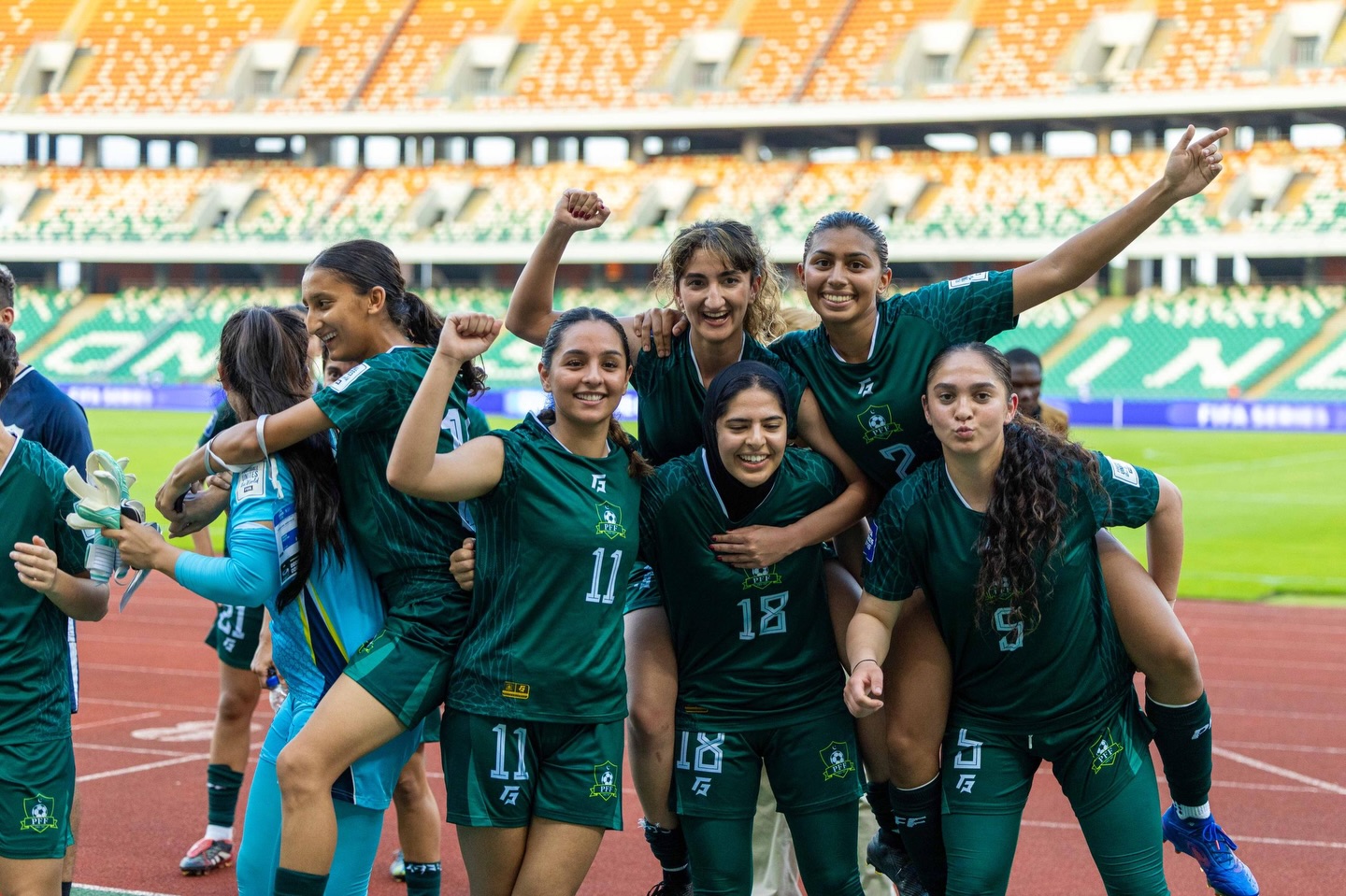
President Gilani’s decision to dedicate this historic victory to national leadership, including Shehbaz Sharif and Syed Asim Munir, may invite varied interpretations. On one hand, it aligns the achievement with a broader national narrative of unity and progress. On the other, it highlights the intricate relationship between sports and state in Pakistan, a dynamic that can both empower and complicate the sporting ecosystem.
However, beyond the politics, the symbolism remains powerful. The women team’s triumph is being framed as a national moment, not just a sporting one. And in a country where collective pride often transcends individual domains, that framing matters.
Yet, ambition without validation often remains hollow. This is where the third major development becomes crucial: FIFA’s explicit endorsement of Pakistan’s football leadership.
The meeting at FIFA headquarters in Zurich, where Mattias Grafström praised the strides made under Gilani, carries significant weight. For years, Pakistan football suffered from credibility deficits at the international level. Administrative instability had eroded trust, both domestically and globally. FIFA’s reaffirmation of support is not merely diplomatic, it is a restoration of confidence.
Even more telling is the nature of the discussions. Governance reforms, infrastructure development, and domestic pathways were highlighted as the three pillars of progress.
These are not abstract concepts; they are the foundational weaknesses that have historically held Pakistan back. Addressing them requires sustained commitment, not just short-term optics.
What stands out, however, is the alignment between vision and execution. The federation’s efforts to expand international engagement, stabilize its internal structures, and invest in new domains like esports suggest a coherent strategy rather than fragmented initiatives. FIFA’s backing, therefore, is both a reward for progress and a reminder of expectations.
Taken together, these three developments; esports integration, FIFA’s endorsement, and the women’s team’s historic win, paint a picture of a federation in transition. But transitions are delicate. They require consistency, transparency, and a great focus on long-term goals.
The challenge for the PFF now is to ensure that these milestones are not fleeting headlines but foundational steps. The esports initiative must evolve into a structured ecosystem with regular competitions, talent identification, and commercial viability. The women team’s success must be nurtured through sustained investment, regular international exposure, and grassroots development. And FIFA’s support must translate into tangible improvements in infrastructure and governance.
There is also a need to bridge the gap between vision and public trust. Pakistani football fans, long disillusioned by administrative chaos, will judge this “new era” not by announcements, but by outcomes. Transparency in decision-making, inclusivity in talent selection, and accountability at all levels will be critical in rebuilding that trust.
Yet, for the first time in a long while, there is a sense of direction. Pakistan football is no longer merely reacting to crises; it is attempting to shape its future. Whether through digital arenas or physical pitches, through administrative reforms or on-field performances, the signs are encouraging.
The road ahead remains long and fraught with challenges. But if these recent developments are any indication, Pakistan football may finally be learning to play not just the game, but the long game.
sarfraznews12@gmail.com